
Common Wiper Blade Problems & Solutions
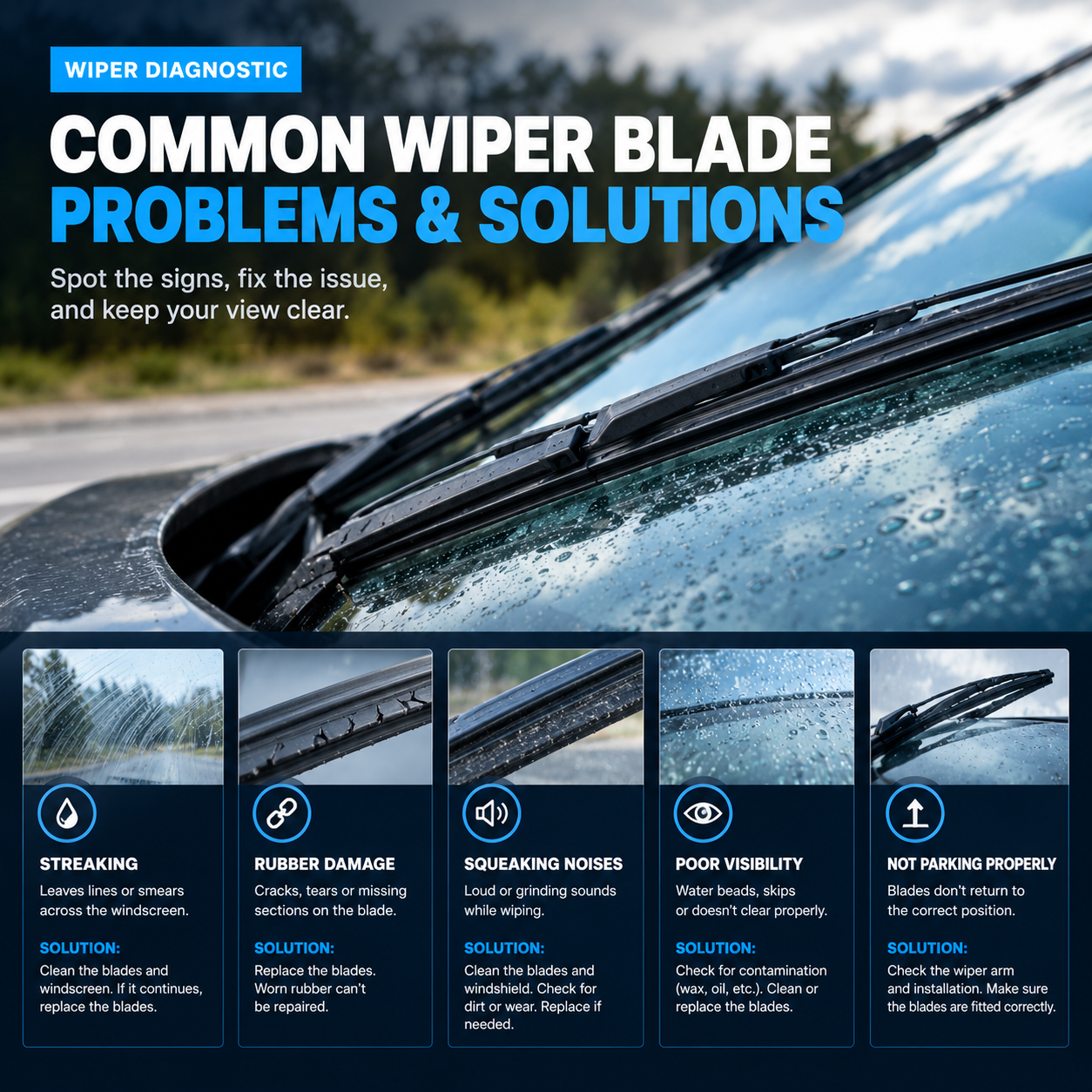
This comprehensive troubleshooting guide will walk you through the eight most common wiper blade problems, show you exactly how to diagnose and fix each one, and help you understand when it’s time to stop fixing and just replace. We’ll also cover the Australian-specific challenges that make our climate particularly tough on wiper blades—from the world’s highest UV levels to coastal salt spray and red dust.
Whether you’re dealing with annoying squeaks, dangerous streaking, or mysterious juddering, this guide has the solution. Most issues can be resolved without spending a cent on new blades, but we’ll also be honest about when replacement is the smarter (and safer) choice.
Quick Diagnostic: Match Your Problem
Before diving into detailed solutions, let’s quickly identify what you’re dealing with. Use this diagnostic flowchart to jump straight to your specific problem:
What’s happening with your wipers?
- Lines or streaks of water left behind → Problem #1: Streaking
- High-pitched squealing or squeaking sound → Problem #2: Squeaking
- Blades skip, bounce, or judder across glass → Problem #3: Juddering/Chattering
- Blades skip over sections leaving dry patches → Problem #4: Skipping Sections
- Glass becomes more opaque and smudgy → Problem #5: Smearing
- Visible gap between blade and windscreen → Problem #6: Not Making Contact
- Blade falls off or won’t stay attached to arm → Problem #7: Won’t Stay Attached
- Wipers don’t move at all → Problem #8: Total Failure
Problem #1: Streaking (Most Common Issue)
What It Looks Like
Streaking is the most common wiper blade complaint, and it’s exactly what it sounds like: after your wipers pass across the windscreen, you’re left with visible lines or streaks of water that haven’t been cleared away. Instead of a clean, transparent view, you get water trails that refract light and reduce visibility—especially dangerous at night when oncoming headlights scatter through those streaks.
What Causes Streaking
Before you blame the blades, understand that streaking has multiple possible causes:
- Dirty blades — The most common culprit. Road grime, oil from the road surface, and even old wax from your windscreen can build up on the rubber edge
- Dirty windscreen — Contaminants on the glass itself prevent a clean wipe, no matter how good your blades are
- Worn rubber edge — UV damage from Australia’s intense sun causes rubber to harden and crack, creating an uneven wiping edge
- Protective film still attached — If you’ve just installed new blades, check whether you removed the protective plastic strip from the rubber edge
- Wrong washer fluid — Some washer fluids leave waxy residues that cause streaking
Solution: 5-Step Fix
Follow these steps in order—most streaking issues resolve by step 4:
- Clean the windscreen thoroughly — Use a quality automotive glass cleaner and a microfiber cloth. Pay special attention to the area where your wipers travel. Remove all wax, oil, and grime. If water doesn’t sheet off the clean glass, there’s still contamination present.
- Clean the wiper blades — Lift the wiper arms away from the windscreen (they’ll lock in the “up” position). Take a damp cloth with a small amount of mild soap or rubbing alcohol and wipe along the entire length of the rubber edge. You’ll likely see black residue on your cloth—that’s the grime that was causing streaks.
- Check for protective covers — On new blades only: inspect the rubber edge closely for a thin plastic protective strip. This is easily missed and will cause terrible streaking. If present, peel it off completely.
- Test the results — Lower the wipers back to the windscreen, spray washer fluid generously, and run the wipers through several cycles. The streaking should be dramatically reduced or eliminated.
- If streaking persists — Inspect the rubber edge up close. Run your finger along it—it should feel smooth and flexible. If you see cracks, tears, or feel hardened rubber, the blade has reached end-of-life and cleaning won’t help. It’s time to replace.
Australian-Specific Cause: UV Hardening
Here’s something many Australian drivers don’t realize: our UV levels are among the highest in the world, and UV radiation is brutal on rubber compounds. While a quality wiper blade might last 18-24 months in Europe or North America, that same blade can start failing at 9-12 months in Australia—especially if you park in full sun.
The UV causes rubber to harden and lose flexibility, which means the blade can no longer conform to your windscreen’s curve. This creates an uneven wiping edge that leaves streaks. Cleaning can’t reverse UV damage, which is why choosing UV-resistant blades (like UNIWIPER’s graphite-coated rubber) is essential for Australian conditions.
Problem #2: Squeaking (The Annoying One)
What It Sounds Like
You know this one—it’s the high-pitched, ear-splitting “eee-eee-eee” sound that happens with every wiper stroke. Sometimes it’s worse on the upstroke, sometimes the downstroke. It might vary with wiper speed. And it’s absolutely maddening, especially on long drives.
What Causes Squeaking
Squeaking happens when the rubber blade doesn’t glide smoothly across the glass—instead, it “sticks and releases” rapidly, creating that characteristic squeal. The main causes are:
- Dirty windscreen — This is the number one cause. Even an invisible film of contaminants can create enough friction to cause squeaking
- Hardened rubber — UV damage and age cause rubber to lose its flexibility and develop a rough surface texture
- Dry wiping — Running wipers without washer fluid creates excessive friction. Never do this, even to clear dust
- New blade break-in — Brand new blades sometimes squeak for the first 10-20 wipes. This is normal and resolves on its own
- Wrong blade angle — If the blade isn’t contacting the glass at the proper angle (caused by a bent wiper arm), it can squeak
Solution: 3-Step Fix
- Deep clean the windscreen — Use an ammonia-based automotive glass cleaner, not household products like Windex (which can leave residue). Clean the entire windscreen, then dry it completely with a microfiber cloth before testing. This single step resolves squeaking about 60% of the time.
- Clean the blade rubber — Wipe the rubber edge with rubbing alcohol on a clean cloth. This removes oils and residue that cleaning with soap might miss.
- Test with washer fluid — Never test wipers dry. Spray a generous amount of washer fluid and run several wiper cycles. The squeaking should be gone or significantly reduced.
If Squeaking Persists
If the squeak continues after cleaning, you’re dealing with one of two scenarios:
- New blades (less than 50 wipes) — Give them more break-in time. The manufacturing coating needs to wear off. Continue using them normally with plenty of washer fluid.
- Old blades — The rubber has hardened beyond recovery. This is especially common in Australia due to UV exposure. Cleaning won’t fix hardened rubber—replacement is the only solution.
Prevention Tips
Prevent squeaking before it starts:
- Always use washer fluid—never dry wipe, even to clear light dust
- Clean your windscreen monthly with proper glass cleaner
- Park in shade when possible to reduce UV degradation
- Choose graphite-coated blades that are designed to glide silently
Problem #3: Juddering or Chattering
What It Looks Like
Juddering (also called chattering) is when your wiper blades skip, bounce, or judder their way across the windscreen instead of gliding smoothly. It creates a jerky, rattling motion and leaves an uneven wipe pattern. It’s both annoying to experience and concerning to watch—it looks like something is mechanically wrong.
What Causes Juddering
Juddering indicates that the blade can’t maintain consistent contact with the glass as it moves. Common causes include:
- Hardened rubber — When rubber loses flexibility, it can no longer smoothly flex and flow across the windscreen’s curve
- Bent wiper arm — The arm might be applying pressure at the wrong angle
- Worn blade spring — In beam blades, the internal spring tension can weaken over time
- Damaged frame — In conventional blades, bent or rusted pivots prevent proper flexibility
- Contaminants on glass — Severe buildup can cause sticking that leads to juddering
Solution: Diagnostic Fix
- Clean everything first — Just like with streaking, start by thoroughly cleaning both the windscreen and the blade rubber. Test after cleaning. If juddering continues, move to step 2.
- Check rubber flexibility — Lift the wiper arm and gently bend the rubber edge with your fingers. It should flex easily and spring back. If it feels stiff or brittle, UV damage has occurred and the blade needs replacement.
- Inspect wiper arm pressure — Push the blade against the windscreen and release. The arm should push the blade firmly against the glass. If the arm feels loose or doesn’t spring back with good tension, the arm spring is weak. This requires a mechanic to replace the wiper arm itself (not the blade).
- Examine the blade frame (conventional blades only) — Look for bent metal pivots, rust, or visible frame damage. If you find any, the blade structure is compromised and needs replacement.
Australian Climate Factor
Juddering is particularly common in Australia because our intense UV radiation hardens rubber faster than manufacturers typically expect. A blade that’s only six months old might already show UV damage if the vehicle is regularly parked in full sun. This is why quality UV-resistant blades, like UNIWIPER’s specially formulated rubber, last significantly longer in Australian conditions.
When to Replace
Replace the blades if you observe any of these signs:
- ✅ Rubber feels hard or inflexible when bent
- ✅ Visible cracks, tears, or chunks missing from the rubber
- ✅ Blades are 9-12+ months old
- ✅ Cleaning doesn’t resolve the juddering
Problem #4: Skipping Sections
What It Looks Like
When your wipers skip sections, they literally skip over parts of the windscreen, leaving dry patches. You’ll see an inconsistent wipe pattern—some areas are clean while others remain wet or streaky. The blade isn’t making consistent contact across its entire length.
What Causes Skipping
Skipping indicates a structural problem:
- Worn blade edge — Uneven wear on the rubber creates low spots that don’t contact the glass
- Loss of frame integrity — In conventional blades, if the metal frame bends or pivots seize up, the blade can’t maintain even pressure across its length
- Bent wiper arm — Similar to juddering, but more severe—the arm isn’t pressing the blade evenly
- Wrong size blade — A blade that’s too short obviously won’t reach the full area. A blade that’s too long can’t follow the windscreen’s curve properly
- Ice or debris stuck to blade — Rare in most of Australia, but can happen in alpine areas
Solution: Fix or Replace
- Visual inspection — Turn on your wipers and watch carefully. Can you see visible gaps between the blade and the windscreen? This tells you where the problem is.
- Verify correct size — Check your vehicle’s manual or look up the correct wiper blade sizes for your make and model. Wrong-size blades can’t make proper contact.
- Check for damage — Examine the blade closely: bent frame, torn rubber, missing adapter pieces, or any visible deformation. These indicate structural failure.
- Clean and test — If everything looks okay, clean the windscreen and blades thoroughly and test again. Still skipping? It’s time to replace.
This Usually Means Replacement
Be honest here: skipping almost always indicates that the blade has reached end-of-life. Unlike squeaking or light streaking, which can be resolved with cleaning, skipping represents structural failure. The blade can no longer maintain its designed pressure distribution across the windscreen.
More importantly, skipping is a safety issue. Those dry patches in your vision are exactly where you might miss seeing a pedestrian, cyclist, or hazard. When blades start skipping, replacement isn’t optional—it’s essential.
Problem #5: Smearing
What It Looks Like
Smearing is arguably worse than streaking—instead of leaving lines of water, your wipers spread a thin film of murky residue across the entire windscreen, making it more opaque than it was before you turned the wipers on. It’s like trying to look through frosted glass, especially dangerous at night when lights scatter through the smeared film.
What Causes Smearing
Smearing happens when contaminants are spread across the glass rather than removed:
- Oily or greasy windscreen — Road grime, diesel exhaust, and old car wax create an oily film that smears when wet
- Contaminated blade rubber — If the blade edge is saturated with oils and dirt, it transfers and spreads contamination with each wipe
- Degraded washer fluid — Old washer fluid can develop bacterial growth or chemical breakdown that causes smearing
- Silicone treatments — Products like Rain-X are great when working properly, but when they start breaking down, they cause terrible smearing
- Very worn blades — When the sharp rubber edge becomes rounded from wear, it can’t effectively clear water and instead pushes and smears it
Solution: Deep Clean
Smearing requires more aggressive cleaning than other problems:
- Windscreen deep clean — Start with an ammonia-based automotive glass cleaner. Apply generously, scrub with a microfiber cloth, and rinse. If smearing persists, you need a clay bar treatment: this automotive detailing technique removes bonded contaminants that cleaning can’t. You can buy a clay bar kit at any auto parts store and use it following the package instructions.
- Blade cleaning — Remove all contaminants from the blade rubber. Use rubbing alcohol on a cloth and wipe the entire length of both blades multiple times. Keep wiping until the cloth comes away clean.
- Fresh washer fluid — If your washer fluid has been sitting in the reservoir for more than 6-12 months, drain it and refill with fresh fluid. Old fluid can develop contaminants that cause smearing.
- Test thoroughly — Spray plenty of washer fluid and run multiple wipe cycles. The smearing should gradually reduce and disappear. If it doesn’t, you’re dealing with worn blades.
If Smearing Continues
Inspect the blade’s rubber edge closely. A new blade has a sharp, crisp edge—almost like a squeegee. A worn blade has a rounded, soft edge. If your blade edge is rounded, it’s too worn to effectively clear water. No amount of cleaning will restore the edge geometry. Time to replace.
Problem #6: Blade Not Making Contact with Windscreen
What It Looks Like
You can literally see a gap between the wiper blade and the windscreen. The blade lifts off the glass, especially noticeable at highway speeds or on curved sections of the windscreen. This creates obviously poor wiping performance in those areas.
What Causes Contact Loss
- Wind lift — Poor aerodynamic design allows wind to get under the blade at highway speeds, lifting it off the glass
- Weak wiper arm spring — The arm’s spring provides the pressure that holds the blade against the windscreen. If it weakens, the blade lifts away
- Bent wiper arm — Physical damage to the arm changes the pressure angle
- Blade too long — An oversized blade can’t follow the windscreen’s curve, especially at the ends
- Lost spring tension — In beam blades, the internal spring can lose tension with age, reducing the blade’s ability to conform to the glass
Solution: Diagnose the Cause
- Size verification — Confirm you have the correct blade length for your vehicle. Check your vehicle’s manual or use an online wiper blade size guide. Even 2-3 cm too long can cause fitting problems.
- Arm pressure test — With the wipers off, manually pull the wiper arm away from the windscreen and release it. It should spring back quickly and firmly against the glass. If it moves slowly or weakly, the arm spring is worn and needs replacement by a mechanic.
- Speed test — Does the gap appear only at highway speeds (100+ km/h)? If so, you’re experiencing wind lift due to poor aerodynamics. This is most common with older conventional-style blades that have an exposed metal frame.
Australian Highway Context
Australian highways run at 100-110 km/h, and at these speeds, aerodynamics matter. Wind lift becomes a real issue with conventional blades or cheap quality blades that lack aerodynamic design. This is one of the key advantages of modern beam blades—they’re specifically designed to hug the windscreen at high speeds.
If you’re experiencing wind lift, upgrading to quality beam blades like UNIWIPER (with aerodynamic design) will completely solve the problem. The enclosed design prevents wind from getting under the blade, maintaining consistent contact even at 110 km/h.
Problem #7: Blade Won’t Stay Attached to Arm
What It Looks Like
Your wiper blade is loose, rattles, slides around on the arm, or—worst case—actually falls off while driving. There’s an obvious lack of secure connection between the blade and the wiper arm.
What Causes Attachment Issues
- Wrong adapter type — Wiper arms come in several different connection types (hook, pin, bayonet, push button). If the blade’s adapter doesn’t match your arm type, it can’t lock securely
- Worn adapter clip — The plastic adapter piece can wear out or crack over time
- Damaged arm hook — The metal hook on the arm itself can bend or break
- Universal adapter not fully engaged — Many replacement blades come with universal adapter kits. If not installed correctly, they won’t lock properly
Solution: Check Fitment
- Identify your wiper arm type — Look at your wiper arm connection. Common types in Australia include:
- Hook (J-hook) — Most common, looks like a metal “J”
- Pin arm — Has a small pin protruding from the arm
- Bayonet — Side-locking mechanism
- Push button — Tab you press to release blade
- Match adapter to arm — Ensure you’re using the correct adapter for your arm type. Universal blade kits include multiple adapters—select the right one and install it properly according to the instructions.
- Test the connection — After installing, the blade should click firmly into place. Try to pull it off—it shouldn’t budge without operating the release mechanism. Any wiggling or movement indicates improper installation.
- Inspect for damage — If the adapter is cracked or the arm hook is bent, no amount of adjusting will help. Cracked adapter means you need a new blade; damaged arm hook requires a mechanic to replace the arm.
UNIWIPER Universal Adapter Advantage
One of the most frustrating aspects of replacing wiper blades is figuring out which adapter you need. UNIWIPER blades come with a complete universal adapter kit that fits virtually all Australian vehicles, plus clear installation instructions with photos. The adapters are engineered for secure locking, so fitment issues are rare. If you’re tired of wrestling with blade installation, quality universal blades like UNIWIPER make the job genuinely easy.
Problem #8: Wipers Not Moving At All
What It Looks Like
You turn on the wipers and… nothing. Either the motor runs but the blades don’t move, or there’s complete silence. Total failure.
What Causes Total Failure
- Mechanical linkage failure — The linkage connecting the motor to the wiper arms has broken or disconnected
- Frozen in place — Blades iced to the windscreen (rare in most of Australia, but possible in alpine areas)
- Motor failure — The wiper motor itself has died
- Electrical issue — Blown fuse, bad relay, or wiring problem
Solution: This Isn’t a Blade Problem
Be clear on this: if your wipers aren’t moving at all, replacing the blades won’t fix it. This is a mechanical or electrical system issue that requires diagnosis and repair.
DIY check: If you’re comfortable with basic car maintenance, you can check the fuses first. Your vehicle’s manual will show the fuse box location and which fuse controls the wipers. A blown fuse is an easy fix.
Otherwise, visit a mechanic. Don’t try to force stuck wipers or disassemble the wiper mechanism without mechanical knowledge—you can cause more damage.
Prevention
- Never force wipers if they’re stuck (like frozen to ice)
- Have your wiper system inspected during regular service
- Address unusual noises or slow wiper movement early (these are warning signs of impending failure)
Australian-Specific Wiper Blade Problems
Now let’s talk about the problems that are uniquely severe in Australia—or that Australian drivers experience more intensely than drivers elsewhere in the world.
UV Degradation: Australia’s Unique Challenge
The Problem: Your wiper blades harden, crack, and fail much faster than the manufacturer’s claimed lifespan.
Why Australia Is Different: Australia has the highest UV levels in the world. Our UV index regularly reaches 11-14 in summer (anything above 11 is classified as “extreme”). This intense UV radiation breaks down rubber compounds at an accelerated rate. A blade that might last 18 months in Europe can fail at 9 months in Perth or Brisbane.
The Solution:
- Choose UV-resistant blades specifically formulated for high UV environments (UNIWIPER blades feature UV-resistant graphite-treated rubber)
- Park in shade whenever possible, especially during the hottest months
- Replace blades proactively at 9-12 months, even if they seem okay—don’t wait for visible failure
- Keep your windscreen clean to reduce the stress on blade rubber
Red Dust Buildup: The Outback Effect
The Problem: After driving through dusty conditions (or even just living in rural areas), you find gritty residue on your blades and terrible wiping performance.
The Cause: Australia’s famous red dust is extremely fine and gets everywhere. When it accumulates on wiper blades and then gets wet, it creates an abrasive paste that scratches your windscreen and damages the rubber.
The Solution:
- Clean your blades immediately after dusty drives—a simple wipe with a damp cloth takes 30 seconds
- Never use wipers on a dusty dry windscreen—spray washer fluid first to wet the dust and prevent scratching
- Monthly blade cleaning is essential if you live in rural or outback areas
- Keep your washer fluid reservoir full—you’ll use more than city drivers
Coastal Corrosion: Salt Spray Damage
The Problem: If you live near the coast, the metal frames of conventional wiper blades rust and corrode rapidly, sometimes in just 6-8 months.
The Cause: Salt spray from the ocean is highly corrosive to metal. Even if you don’t drive right at the beach, coastal air carries salt that settles on your vehicle and accelerates metal corrosion.
The Solution:
- Switch to beam blade design—there’s no exposed metal frame to corrode. The entire mechanism is enclosed in rubber
- If you must use conventional blades, rinse them with fresh water monthly to remove salt buildup
- Expect to replace conventional blades more frequently if you live within 5 km of the coast (8-10 months instead of 12)
- Check blades regularly for rust spots—corrosion weakens the frame and causes structural failure
First-Rain Smearing: After Long Dry Spells
The Problem: After weeks or months of dry weather (common in Australian summer), the first rain produces terrible wiper performance—smearing, squeaking, or streaking—even though the blades were fine last time you used them.
The Cause: Extended exposure to heat and UV while sitting unused causes the rubber to harden and develop a surface crust. The first rain reactivates this, causing poor performance.
The Solution:
- Test your wipers before the wet season arrives (spring in southern Australia, October in the north). This gives you time to replace them before you desperately need them
- If performance is poor after a dry spell, try a few cleaning cycles—sometimes the rubber “remembers” and performance improves
- If cleaning doesn’t help immediately, replace the blades before the rainy season starts
- Quality blades with better rubber compounds (like UNIWIPER) maintain flexibility better through dry periods
Maintenance to Prevent Problems
An ounce of prevention truly is worth a pound of cure when it comes to wiper blades. Simple regular maintenance can extend blade life and prevent most of the problems we’ve discussed.
Monthly Quick Maintenance (2 Minutes)
Set a reminder on your phone to do this once a month—it takes less time than a coffee break:
- Clean the blades: Lift the wiper arms, wipe the rubber edge with a damp microfiber cloth. You’ll remove accumulated grime before it becomes a problem.
- Clean the windscreen: Use glass cleaner on the entire windscreen, paying special attention to the wiper path.
- Visual inspection: Look for obvious damage—cracks, tears, or bent frames. Catching issues early prevents being caught out in a rainstorm.
- Function test: Spray washer fluid and run the wipers through a few cycles. How’s the performance? Any new noises?
Seasonal Maintenance: Australian Context
Time your maintenance to match Australia’s regional rainfall patterns:
Before the wet season (October–March in northern Australia, May–September in southern Australia):
- Test wiper performance thoroughly
- Replace blades if there are any performance issues—don’t wait until you’re in a downpour
- Top up washer fluid reservoir completely
- Clean the entire windscreen, inside and out
Summer parking strategy:
- Use a windscreen sunshade—this protects both the glass and the wipers from UV damage
- Park in shade when available
- If you have a garage, use it—this can double your blade lifespan
After bush driving:
- Clean blades and windscreen immediately upon returning to paved roads
- Check for embedded particles in the blade rubber
- Spray and wipe multiple times to remove all dust
When to Just Replace Instead of Fixing
Let’s be honest about when troubleshooting isn’t worth your time.
Replace Immediately If You See:
- ✅ Age 12+ months — Even if they seem fine, Australian UV means they’re living on borrowed time
- ✅ Visible cracks or tears — Damaged rubber can’t be repaired and will only get worse
- ✅ Cleaning doesn’t help — If you’ve thoroughly cleaned everything and problems persist, the blades are worn out
- ✅ Bent or corroded frame — Structural damage (in conventional blades) means the blade can’t perform properly
- ✅ Hard, inflexible rubber — UV-damaged rubber has lost the flexibility needed to wipe effectively
- ✅ Safety concern — If you’re struggling to see in rain, don’t gamble. Replace immediately
The Math: Repair vs Replace
Let’s do some honest math on whether extended troubleshooting makes sense:
Troubleshooting Path:
- Time spent: 15-30 minutes (often spread over multiple attempts)
- Cost of cleaning supplies: $5-10
- Success rate on blades 9+ months old: 30-40%
- Risk: Caught in heavy rain with poor visibility
Replacement Path:
- Time to install: 5 minutes
- Cost of quality blades: $40-60 for a pair
- Success rate: 100%
- Bonus: 9-12 months of reliable performance
The verdict: For blades approaching or past 9 months old, replacement is almost always the smarter choice. Clean them once as a quick test, but if problems persist, don’t waste time on extensive troubleshooting. Your safety and peace of mind are worth more than $50.
Choosing Blades That Avoid These Problems
Want to prevent most of these problems in the first place? The right wiper blade choice makes a massive difference.
Features That Prevent Common Issues
When choosing replacement blades, look for these problem-preventing features:
- UV-resistant rubber compound — Prevents premature hardening, cracking, and degradation from Australian sun. This addresses streaking, squeaking, and juddering.
- Beam blade design — Enclosed construction with no exposed metal prevents corrosion (crucial for coastal areas), provides better aerodynamics (prevents wind lift), and maintains more even pressure across the windscreen (prevents skipping).
- Quality rubber formulation — Premium rubber maintains flexibility longer, especially through hot, dry periods. This prevents most performance issues.
- Graphite coating — Reduces friction between blade and glass, preventing squeaking and extending blade life. The graphite provides natural lubrication.
- Universal adapter kit — Ensures proper fitment to your specific wiper arm type, preventing attachment issues. Good kits include clear instructions.
Why UNIWIPER Addresses These Problems
UNIWIPER blades were specifically designed with Australian conditions in mind, addressing the exact problems we’ve covered in this guide:
- ✅ UV-resistant graphite-treated rubber — Formulated and tested for Australian UV levels, not just European standards
- ✅ Beam blade design — No exposed metal frame means no coastal corrosion and better performance at highway speeds
- ✅ Aerodynamic profile — Maintains windscreen contact even at 110 km/h, eliminating wind lift
- ✅ Complete universal adapter kit — Includes all common adapter types with clear installation instructions for proper fitment
- ✅ Premium rubber compound — Maintains flexibility and performance for 9-12 months in Australian conditions
- ✅ Australian-designed — Not a European or American blade adapted for our market—actually engineered for our specific challenges
The result? Fewer problems, longer lifespan, and better performance when you actually need it—during that sudden storm on the highway.
Tired of Wiper Problems? Choose UNIWIPER
UV-resistant, Australian-designed beam blades that prevent common problems
Frequently Asked Questions
Why do my wiper blades squeak on a clean windscreen?
If you’ve thoroughly cleaned the windscreen and the blades still squeak, the rubber has likely hardened from age or UV damage. Try wiping the blade rubber with rubbing alcohol—this removes invisible residues. If squeaking continues after this, the rubber’s surface has become rough from UV degradation and the blades need replacement. New blade squeaking is normal for the first 10-20 wipes and will resolve as the factory coating wears off.
Can I fix wiper blade streaking without replacing?
Yes, in many cases. Start by thoroughly cleaning both the windscreen (with glass cleaner) and the blade rubber (wipe with damp cloth and mild soap). This fixes streaking about 70% of the time. Test with washer fluid. If streaking persists, inspect the rubber edge—if it’s cracked or hardened, cleaning won’t help and replacement is needed. Also check that you removed any protective plastic strip if the blades are new.
Why do my wipers judder even though they’re new?
New blades that judder usually indicate one of three things: (1) The windscreen has contamination that needs deep cleaning—try a clay bar treatment to remove bonded contaminants; (2) The wiper arm is bent or has incorrect tension—test by pulling the arm away and releasing it, it should spring back firmly; or (3) Very rarely, you received a defective blade with improper spring tension. Clean everything thoroughly first, then check arm pressure before considering a warranty claim.
How do I stop wiper blades from chattering?
Chattering (same as juddering) is usually caused by hardened rubber or contaminated glass. Clean the windscreen with ammonia-based glass cleaner and the blade rubber with rubbing alcohol. Test the rubber flexibility—bend it gently; it should flex easily. If it feels stiff or brittle, UV damage has occurred and you need new blades. In Australia, chattering is commonly a sign that the rubber has been hardened by our intense sun.
Why are my wipers leaving streaks after I just replaced them?
New blades that streak usually mean: (1) You didn’t remove the protective plastic edge guard—check the rubber edge for a thin clear plastic strip and peel it off; (2) The windscreen is contaminated—wax, oils, or silicone treatments on the glass will cause brand new blades to streak; or (3) You’re using contaminated washer fluid. Clean the windscreen thoroughly, ensure protective covers are removed, and refill with fresh washer fluid. New blades on a clean windscreen should perform perfectly.
Can I repair a torn wiper blade?
No. Once the rubber is torn or cracked, there’s no effective repair. The rubber edge needs to be perfectly smooth and continuous to wipe effectively. Any tear or crack will allow water through and cause streaking or skipping. Attempting to glue or patch rubber won’t work—the repair won’t withstand the pressure and flexing. Replace the blade immediately, as a torn blade can worsen quickly and even damage your windscreen.
Why do my wipers smear instead of clean?
Smearing indicates contamination being spread across the glass. Common causes: (1) Oily windscreen from road grime or diesel exhaust—needs deep cleaning, possibly with a clay bar; (2) Degrading Rain-X or similar coating—strip it off completely and start fresh; (3) Old contaminated washer fluid—drain and refill; or (4) Very worn blade rubber with a rounded edge that can’t effectively clear water—inspect the edge and replace if rounded. Always clean both windscreen and blades thoroughly before assuming the blades are worn.
How do I know if the problem is the blade or the wiper arm?
Test the wiper arm: Pull it away from the windscreen and release. It should spring back quickly and firmly. Weak or slow return indicates a worn arm spring. Check for visible bending in the arm. Swap the blades left-to-right: if the problem moves with the blade, it’s the blade; if it stays in the same position, it’s the arm or windscreen. Also consider age: blades wear out in 9-12 months in Australia; wiper arms typically last many years. If both blades have the same problem, it’s probably the blades. If only one side has issues, check that arm.
Quick Reference: Problem-Solution Cheat Sheet
Save or print this quick-reference table for fast problem diagnosis:
| Problem | Quick Fix (Try First) | If That Doesn’t Work |
|---|---|---|
| Streaking | Clean windscreen and blade rubber thoroughly | Replace blades (UV-damaged rubber) |
| Squeaking | Deep clean glass with glass cleaner, wipe blade with alcohol | Replace if rubber is hardened |
| Juddering | Clean everything, test rubber flexibility | Replace if rubber is stiff/inflexible |
| Skipping sections | Verify correct blade size, check for frame damage | Usually means replace (structural failure) |
| Smearing | Deep clean glass (possibly clay bar), clean blade, fresh fluid | Replace if blade edge is rounded |
| Not contacting glass | Verify size, test wiper arm pressure/spring | Replace with beam blades (wind lift) or see mechanic (weak arm) |
| Won’t attach | Verify correct adapter type, check for click-lock | Replace with correct adapter or see mechanic (damaged arm) |
| Not moving | Check fuses (if DIY-capable) | Mechanic needed (not a blade issue) |
Conclusion: Most Problems Are Preventable
After walking through all eight common wiper blade problems and their solutions, here’s the empowering truth: you can prevent about 80% of these issues with simple regular maintenance and smart blade choices.
The 2-minute monthly maintenance routine—cleaning your windscreen and blades, doing a quick visual inspection, and running a test cycle—catches problems before they become failures. This simple habit means you won’t be caught in a downpour with useless wipers.
Equally important is understanding that Australian conditions are genuinely harder on wiper blades than most other climates. Our extreme UV levels, temperature swings, coastal salt, and red dust create challenges that European or American blades aren’t designed for. When choosing replacement blades, UV resistance isn’t a luxury feature—it’s essential for longevity and reliable performance.
Know when to clean and when to replace. Cleaning can fix many problems—streaking, squeaking, light smearing—especially if your blades are relatively young (under 6 months). But once blades show hardened rubber, cracks, tears, or persistent skipping, no amount of cleaning will restore them. At that point, replacement isn’t optional—it’s a safety requirement.
Quality matters more than you might think. The difference between cheap blades and quality UV-resistant beam blades isn’t just longevity (though 12 months vs. 6 months is significant)—it’s reliability when you desperately need it. That moment when visibility drops to 20 meters on the highway in a storm isn’t the time to discover your budget blades can’t handle the job.
Finally, remember that wiper blade problems aren’t just annoying—they’re safety issues. Poor visibility in rain contributes to accidents. If you’re struggling to see, don’t delay replacement while trying endless troubleshooting. Your life and the lives of your passengers and other road users are worth far more than $50 in wiper blades.
Choose Problem-Free Performance
UNIWIPER blades: UV-resistant, Australian-tested, designed to prevent these exact problems
Related Troubleshooting and Guides
- How to Replace Wiper Blades — Complete 5-minute DIY installation guide with photos
- Best Wiper Blades Australia 2026 — Avoid problems by choosing quality blades from the start
- How Often to Replace Wiper Blades — Replacement schedule to prevent issues before they occur
- Wiper Blades for Australian Weather — Understanding UV damage and climate impact
- Beam vs Conventional Wiper Blades — Why beam blades have fewer problems and last longer
